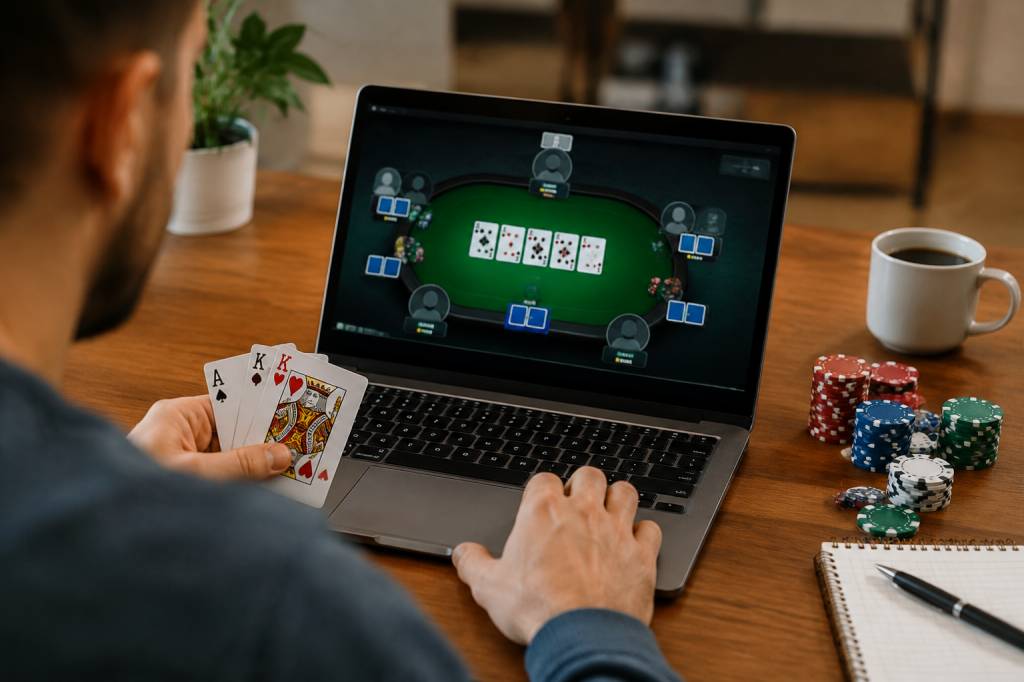
Online poker has a peculiar talent: it can make a quiet evening feel like the final table of a major tournament. One minute you are sipping coffee in your slippers; the next, you are deciding whether a river bet is a bluff or a very confident value play. The convenience is part of the appeal, but getting better takes more than clicking “raise” with a hopeful grin. It takes a plan, a little patience, and the ability to learn from hands that do not go your way.
Here is how I approach online poker: I keep my decisions simple, pay attention to the details, and treat every session as a chance to improve. You do not need to be a professional or memorize a library of poker theory to make progress. You do need to think clearly, manage your bankroll, and remember that even a good decision can lose a hand.
Start with a game you understand
“Online poker” covers a lot of ground. You might play cash games, sit-and-go tournaments, or multi-table tournaments, each with a different pace and pressure. Before choosing a table, ask yourself what you want from the session. Do you have an hour to play a few cash-game hands, or a whole evening for a tournament that might last much longer than expected?
When I started taking online poker more seriously, I made the classic mistake of jumping between formats. A little cash game here, a tournament there, then a quick experiment with a different variant because the lobby looked tempting. It felt adventurous, but it made it hard to tell whether I was improving. Sticking with one format for a while helps you learn its rhythm and spot your own habits.
If you are new to the game, begin with stakes that feel comfortable and rules you know well. Texas hold’em is a common starting point because the basic structure is easy to follow. That does not mean it is easy to master, of course. Poker has a way of making simple rules produce wonderfully complicated decisions.
Choose your starting hands with care
One of the most useful improvements I made was learning to fold more often before the flop. It is not glamorous. Nobody tells a legendary story about folding nine hands in a row. But saving chips with weak starting hands gives you more room to play when you do have a sensible reason to enter a pot.
Good starting hands depend on your position, the action before you, and the players at the table. A strong pair can be played differently from an early position than from the button, where you will usually act later after the flop. Position matters because information matters: when other players have already acted, you have clues about how interested they are in the pot.
Rather than memorizing an enormous chart on day one, focus on a few practical questions:
- How strong is my hand compared with the hands I might face?
- What is my position, and how many players are still to act?
- Has someone raised already, and what does that raise suggest?
- Am I entering the pot with a plan, or simply because I am bored?
That last question has saved me from plenty of unnecessary calls. Boredom is not a poker strategy, even if it sometimes disguises itself as “just seeing one more flop.”
Make position work for you
Position is one of the clearest advantages you can have at a poker table. Acting later gives you more information about what your opponents have chosen to do. You can make better-informed decisions about whether to bet, call, or fold, while a player acting first has to make a decision with less to go on.
In late position, you can often play a wider range of hands than you would from an early seat, provided the action and table conditions make sense. In early position, a tighter approach is often wiser because several players still have the opportunity to act behind you. This is not a magic rule that guarantees wins; it is a way of avoiding difficult spots when you do not have much information.
I like to think of position as a small spotlight. It does not reveal everyone’s cards, sadly, but it helps illuminate the situation before you put more chips in. Online, where you cannot read a raised eyebrow or a nervous sip of water, those betting actions become even more important.
Watch the action, not just your cards
It is tempting to focus only on your own hand. The stronger habit is to watch how the whole hand develops. Who raised before the flop? Who called? Did the player who seemed quiet suddenly make a large bet? What changed on the turn or river?
Online poker offers helpful information through the betting history and hand replay tools available on many platforms. Use them. A player who raises frequently from late position may be applying pressure with a wide range. Someone who has called every street and then makes a large river raise may be telling a different story. These are clues, not certainties. The aim is not to label an opponent after one hand, but to build a more accurate picture over time.
In one session, I kept seeing the same opponent raise small before the flop and then give up on the turn whenever called. I began to notice the pattern and adjusted by calling in position with hands that could continue. It was not a dramatic read worthy of a movie soundtrack. It was simply paying attention—and that often matters more than making a flashy move.
Think in ranges, not certainties
A common beginner’s question is, “What does that player have?” The more useful question is, “What hands could that player reasonably have here?” A range is a group of possible hands rather than one exact answer. Thinking this way keeps you from treating a guess as a fact.
For example, an early-position raise may represent a fairly strong set of hands, while a button raise can include more possibilities. The board, the size of the bets, and the opponent’s previous actions all help narrow the range. You do not need to calculate every combination at the table. Even a basic range-based approach is a big step up from deciding that someone “must have a king” because a king appeared on the flop.
Try to make each decision about the likely situation, not about the hand you hope your opponent has. Hope is welcome at the table, but it should not be in charge of the chips.
Use bet sizing with a purpose
Every bet should have a reason. Are you betting for value, hoping a weaker hand will call? Are you bluffing to make a better hand fold? Are you protecting a vulnerable hand? If you cannot explain the purpose of your bet, pause before clicking.
Consistent bet sizing can make your decisions easier and prevent you from giving away information without meaning to. If you bet tiny with strong hands and huge with bluffs, attentive opponents may catch on. At the same time, there is no single bet size that works in every situation. The board, pot size, number of opponents, and their likely ranges all matter.
A practical habit is to look at the pot before choosing an amount. Ask whether your bet is large enough to achieve its goal, but not so large that you risk more than the situation justifies. A bet is not automatically better because it looks bold on the screen.
Review hands after the session
Playing more hands can help, but playing more without reflection can also repeat the same mistakes at higher speed. A short review after a session is one of the simplest ways to improve. Save hands that felt difficult, surprising, or emotionally charged, then examine them when you are calm.
For each hand, write down what you knew at the time and why you chose to act. Then consider what you might do differently. Be fair to yourself: a loss does not automatically mean you played badly, and a win does not prove that every decision was perfect. Poker rewards good decisions over time, not the outcome of one memorable pot.
- Mark hands where you were unsure about your position or starting range.
- Review large pots, especially when you felt rushed or frustrated.
- Look for repeated habits, such as calling too often on the river.
- Compare your reasoning with a trusted learning resource or study partner.
Keep the review focused. You do not have to analyze every hand from a three-hour session. Two or three thoughtful reviews can be more useful than an exhausted attempt to solve the entire evening at once.
Manage your bankroll and your time
Bankroll management is not the most exciting part of poker, but it is what lets you keep playing through normal swings. Set aside only money you can afford to lose, and choose stakes that do not put pressure on your finances. If a buy-in feels frighteningly large, it is probably not the right level for a relaxed learning session.
Decide in advance how much you are willing to spend and how long you plan to play. A session limit helps you step away before fatigue or frustration takes over. It also stops the familiar trap of chasing losses because you feel certain that the next hand will fix everything. The next hand might be a winner. It might also be another lesson in why limits matter.
Poker should remain entertainment, not a way to solve money problems. If playing stops feeling enjoyable or you find it difficult to stick to your limits, take a break and seek support. Responsible play is not an accessory to the game; it is part of playing well.
Keep your emotions out of the driver’s seat
Every online player eventually meets a bad beat: the favorite hand loses to an unlikely card, and the chat box suddenly seems like a tempting place to deliver a speech. I understand the impulse. I have stared at the screen after a river card as if the software might reconsider. It has not yet done so.
The important thing is what happens next. If frustration makes you play looser, chase pots, or raise just to prove a point, take a break. A few minutes away from the screen can be worth more than another orbit played on autopilot. You are not required to win back a lost pot from the same opponent, and the deck does not keep score of your grievances.
Try a simple routine: breathe, note what happened, and decide whether you are still making clear decisions. If not, end the session. Discipline is not never feeling annoyed; it is refusing to let annoyance choose your next bet.
Build a steady learning routine
Improvement does not have to mean studying poker for hours every day. A sustainable routine might include a focused session, a brief hand review, and one topic to work on next time. For example, you could spend a week paying closer attention to position, then focus on river decisions the following week.
Choose learning materials that explain their reasoning rather than simply presenting a list of “correct” moves. Discussing hands with a thoughtful friend can help too, especially if both of you are willing to question your assumptions. The goal is not to sound clever. It is to understand why a decision makes sense and when the circumstances might call for something different.
Track a few useful habits: how often you play while tired, whether you follow your time and spending limits, and which situations cause the most uncertainty. You do not need a complicated spreadsheet to make progress. Honest notes are enough to reveal patterns.
Play the long game
Getting better at online poker is less about finding one secret trick and more about making many small improvements. Choose a format you enjoy, respect position, think about ranges, and give every bet a purpose. Review tough hands without judging yourself by the result, and protect your bankroll with clear limits.
Most of all, stay curious. A hand that goes wrong can still teach you something, and a quiet fold can be a better play than a heroic call. The screen may hide your opponents’ faces, but it cannot hide your decisions from you. Pay attention to them, keep the game responsible, and let the next session be a little smarter than the last.