

Online poker has a special talent for making a quiet evening feel like the final hand of a tournament. One minute you are settling in with a drink; the next, the river card lands and your carefully constructed plan is either a work of art or a very expensive misunderstanding. The good news is that you do not need a professional’s instincts to enjoy live poker online. You do need to know the rules, understand the pace of the game, and keep your decisions steadier than your pulse.
This guide focuses on online Texas Hold’em, the most widely played poker format. The basic rules are straightforward, but the strategy has plenty of depth. Whether you are joining your first cash game or looking to sharpen your approach, a little preparation can make the experience more enjoyable—and help you avoid treating every pair of cards like a personal invitation to go all in.
What Does Live Poker Online Mean?
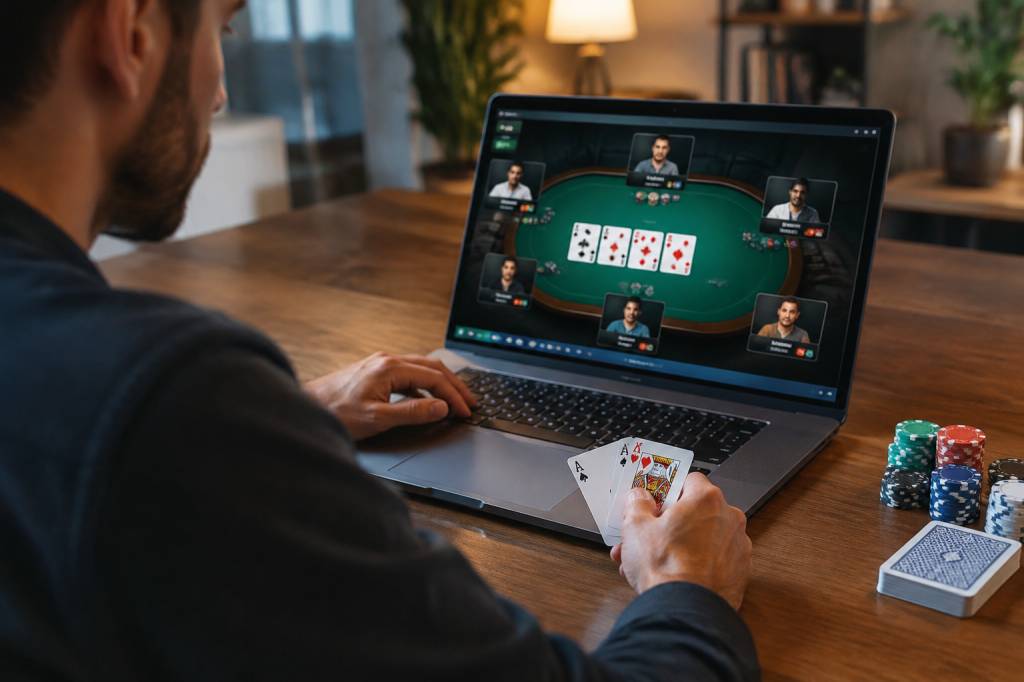
Online poker usually brings together players at a digital table, with software dealing the cards and managing bets. Some platforms also offer live-streamed poker games, where a human dealer handles the action in real time. The exact setup varies, but the core rules remain much like those of a traditional poker table: players compete to make the strongest five-card hand or persuade everyone else to fold.
Before you sit down, check the game type, stakes, table size, and betting structure. A low-stakes cash game is a different animal from a fast-paced tournament. In a cash game, chips represent money and you can generally leave between hands. In a tournament, you pay an entry fee, receive a stack of tournament chips, and play until you are eliminated or the event ends.
Also make sure the platform is available and legal where you live. Read its rules and payment terms, and choose a reputable operator with clear security and responsible-play information. A smooth interface is nice; knowing where your money is going is nicer.
The Basic Rules of Texas Hold’em
Each player receives two private cards, known as hole cards. Five community cards are then dealt face up in the middle of the table. Your goal is to make the best five-card poker hand using any combination of your two hole cards and the five community cards. You may use both hole cards, one, or neither.
A hand typically moves through four betting rounds:
- Pre-flop: Players receive their hole cards and decide whether to fold, call, or raise.
- The flop: Three community cards are dealt, followed by another betting round.
- The turn: A fourth community card appears, then players bet again.
- The river: The fifth and final community card is dealt, followed by the last betting round.
If two or more players remain after the final bet, they reveal their cards at the showdown. The best five-card hand wins the pot. If everyone but one player folds, that remaining player takes the pot without needing to show their cards. Sometimes the most powerful hand is not a pair of aces; it is the ability to make everyone believe you have them.
In most games, two players post forced bets called the small blind and big blind before the cards are dealt. These positions move around the table after each hand. The player immediately to the left of the big blind usually acts first before the flop, while the dealer button generally acts last in later betting rounds. Acting later is useful because you have more information about what your opponents have done.
Know the Hand Rankings
Learning the hand rankings is essential. From strongest to weakest, the standard order is:
- Royal flush: Ten, jack, queen, king, and ace of the same suit.
- Straight flush: Five consecutive cards of the same suit.
- Four of a kind: Four cards of the same rank.
- Full house: Three of a kind plus a pair.
- Flush: Five cards of the same suit, not in sequence.
- Straight: Five consecutive cards of different or matching suits.
- Three of a kind: Three cards of the same rank.
- Two pair: Two separate pairs.
- One pair: Two cards of the same rank.
- High card: When no other hand is made, the highest card plays.
Ace can be high or low in a straight: ace, king, queen, jack, ten is the highest straight, while ace, two, three, four, five is the lowest. Suits do not have a ranking over one another. If two players make the same hand strength, the best five-card combination determines whether the pot is split. A kicker—the extra card used to break a tie—can matter more than newcomers expect.
Make Decisions Before the Flop
The first strategic question is not “How do I win this hand?” It is “Is this hand worth playing from this position?” Strong starting cards such as high pairs and ace-king are often worth entering with. Weak, disconnected cards are harder to turn into strong hands and can become costly distractions.
Position changes the value of your cards. From an early position, several opponents still have to act, so a cautious selection of starting hands is sensible. From a late position, you can see what others have done first and may be able to play a wider range. The dealer button is a coveted seat for a reason: information is a quiet advantage, and it does not even need to wear sunglasses.
Pay attention to the action in front of you. If several players have called a raise, a modest hand may be less attractive than it first appeared. If everyone folds to you in a late position, a raise can sometimes win the blinds immediately. The key is to make these decisions deliberately, rather than clicking “call” because folding feels like admitting defeat.
Bet with a Plan
Every bet should have a purpose. You might bet for value, hoping a weaker hand will call; bluff, aiming to make a stronger hand fold; or protect a hand that could be overtaken by later cards. If you cannot explain what your bet is trying to achieve, pause before making it.
Think about the pot size and the price of a call. Suppose the pot contains $20 and an opponent bets $10. You would need to call $10 to compete for a final pot of $40, assuming no further bets. That price may be reasonable with a strong draw, but not necessarily with a weak hand and little chance to improve. You do not need complicated calculations for every decision. A basic sense of risk versus reward already beats playing on autopilot.
Keep your bet sizing consistent with the situation. A tiny bet may give opponents an appealing price to chase a draw; a huge bet may scare away the weaker hands you hoped would call. Avoid choosing bet sizes solely because you are excited, irritated, or eager to “get the hand over with.” Your chips are not a volume control.
Read the Table, Not Just Your Cards
Online play removes some physical tells, but it does not remove useful information. Observe how often opponents enter pots, how aggressively they raise, and whether they tend to fold when faced with pressure. A player who has folded repeatedly may be cautious; a player who calls every bet may be difficult to bluff. These are clues, not guarantees, so avoid turning one odd hand into a sweeping theory.
Watch the board, too. If three cards of the same suit appear, a flush may be possible. If the community cards form a sequence, a straight may be lurking. A pair of kings can look imposing before the flop and much less comfortable on a board that offers several ways for an opponent to make a stronger hand.
For example, imagine you hold ace-king and the flop comes king, seven, and two. You have top pair with a strong kicker, often a good hand. But if the turn and river bring cards that complete an obvious straight or flush, reassess. Good players do not marry their first impression. They update it as the hand develops.
Bluff Carefully and Choose Your Moments
Bluffing is part of poker, but it is not a requirement to perform in every hand. A bluff is more convincing when the story makes sense: your betting line should represent a hand you could realistically hold, and the board should support that story. Bluffing several opponents at once is usually riskier than bluffing one, because more players means more chances that someone has a hand they like.
Consider your opponent. If they have already shown they hate folding, a dramatic raise may simply earn you an expensive call. If they are capable of letting go of a marginal hand, a well-timed bet could work. Your table image matters as well. Someone who has been raising every hand may not be believed when they suddenly announce, through a large bet, that they have the nuts.
Bluffs are tools, not magic spells. They fail regularly, including at the worst possible moment. The useful question is not “Will this bluff always work?” It is “Does this play have a reasonable chance of working, and is the risk worth it?”
Adapt to the Online Pace
Online tables can move quickly, especially when you play more than one table. Start with a single table until you are comfortable with the software, betting controls, and timing. Check the amount you are raising before you confirm the action; a misplaced click can turn a sensible bet into an accidental declaration of war.
Make use of the hand history or replay features if the platform provides them. Reviewing a difficult hand after the session is often more helpful than replaying it angrily in your head. Ask yourself what you knew at each stage, what you expected your opponent to do, and whether the decision made sense before you saw the final card.
Do not confuse a bad result with a bad decision. If you make the right call against a draw and your opponent hits it on the river, you may simply have encountered poker’s favourite plot twist. Conversely, winning a hand does not automatically mean every choice you made was sound. Judge the decision by the information available at the time, not just by the card that arrived last.
Set Limits and Keep the Game Enjoyable
Choose a budget before you play and treat it as the cost of entertainment, not money you need to win back. Decide how long you will play, and take breaks when your attention starts to wander. Chasing losses, increasing stakes out of frustration, or playing while tired can turn an enjoyable game into a poor decision-making contest.
Cash games and tournaments both carry risk. Never borrow money to play, and do not stake funds needed for bills or essentials. If the game stops feeling fun or you find it difficult to stick to your limits, step away and use the platform’s available time-outs, deposit limits, or self-exclusion tools. Taking a break is not a fold from life; it is often the smartest play at the table.
A Stronger First Session
Before your next game, keep a few fundamentals in mind: learn the hand rankings, start at stakes you can comfortably afford, play fewer weak hands from early positions, and pay attention to how opponents behave. Give each bet a purpose, watch how the board changes, and review a hand or two afterward.
Most of all, remember that poker rewards patience as much as boldness. You will fold good-looking cards, lose pots you thought were yours, and occasionally win with a hand that makes you wonder whether the table has noticed. That is all part of the game. Play within your limits, enjoy the decisions, and let the next hand arrive on its own schedule.