

Free poker tournaments are a great way to learn the game without putting your bankroll on the line. They offer the same mix of decisions, pressure, and occasional bad beats as paid events—just without the buy-in. That makes them ideal for beginners who want to understand tournament poker before risking real money. Think of them as a practice table with a leaderboard: the chips may be virtual, but the lessons are very real.
Still, “free” does not mean “no rules,” and it certainly does not mean every hand is worth playing. A few basic principles can help you avoid common mistakes, make better decisions, and enjoy the game whether you finish first or get knocked out by a river card that seems to have a personal grudge.
What Is a Free Poker Tournament?
A free tournament, often called a freeroll, is a poker event that does not require an entry fee. Players receive a starting stack of tournament chips and compete until one player has all the chips or the event reaches its payout stages. Some freerolls award cash or prizes; others offer tickets to larger tournaments, bonus funds, or simply a chance to practise.
Although there is no entry fee, the format usually follows the same structure as a regular tournament. Blinds increase at set intervals, players are eliminated when they lose all their chips, and the remaining field competes for a finishing position. In some events, players can re-enter or add chips during an early period. Always check the tournament lobby before joining: the details can change how you should play.
One important point: tournament chips are not the same as cash in your account. Their purpose is to keep score and determine your progress. A big stack can give you more options, but it is not money you can withdraw.
The Basic Rules You Need to Know
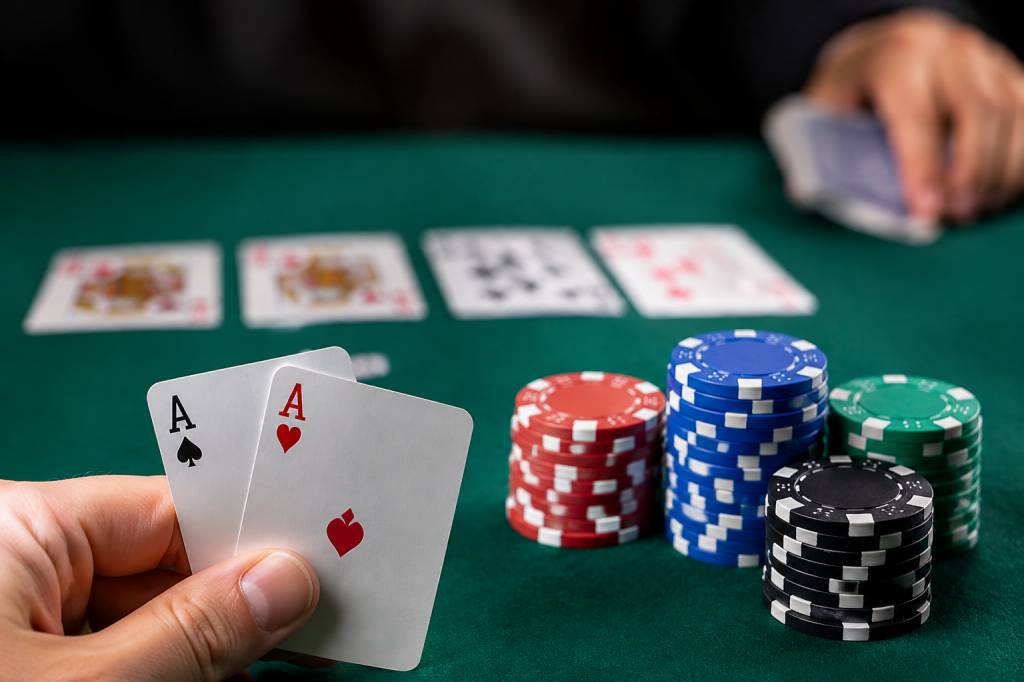
Most online freerolls use Texas Hold’em, so each player receives two private cards. Five community cards are then dealt face up across the table. Your best five-card hand is made from any combination of your two cards and the community cards.
A hand moves through several betting rounds. The first two players to the left of the dealer button usually post the small blind and big blind. These forced bets get the action started. As the button moves around the table, the blinds move with it, so everyone takes a turn paying them.
-
Pre-flop: Players decide whether to fold, call the big blind, or raise after receiving their private cards.
-
The flop: Three community cards are dealt, followed by another betting round.
-
The turn: A fourth community card appears, and another round of betting takes place.
-
The river: The fifth and final community card is dealt. After the last betting round, players still in the hand reveal their cards at showdown.
The player with the strongest five-card hand wins the pot, unless everyone else folds first. If two or more players have equally strong hands, the pot is split. You do not have to use both of your private cards; sometimes the best hand is made entirely from the community cards.
Tournament play adds one rule that changes everything: when your chips are gone, you are out—unless the event allows a re-entry or rebuy. Unlike a cash game, you cannot simply reach into your pocket and buy back the chips at any time.
Read the Tournament Details Before You Join
Before the first hand, look for the starting stack, blind levels, blind duration, number of re-entries, and prize structure. These details tell you what kind of event you are entering. A tournament with a large starting stack and slow blind increases gives you more room to wait for good situations. A fast structure puts pressure on players earlier and rewards timely aggression.
Check whether the tournament is six-handed or full-ring, too. With fewer players at the table, you will be dealt into the blinds more often and must usually play a wider range of hands. A strategy that works at a table of nine players may become too cautious at a table of six.
It is also worth checking the time commitment. A freeroll can last much longer than expected, especially when there are hundreds or thousands of entrants. If you need to leave halfway through, you may be forced to abandon your stack. Even free chips deserve a little respect.
Start Selective, Not Shy
Beginners often make one of two mistakes: playing nearly every hand because the tournament is free, or folding everything until the blinds eat away their stack. A stronger approach is selective aggression. Choose sensible hands, and when you do enter a pot, have a reason for doing so.
From early position, when many players still have a chance to act behind you, stick mostly to strong hands: high pairs, strong ace combinations, and well-connected high cards. From later position, particularly on the button, you can consider more hands because fewer opponents remain to act. Position gives you information, and information is one of poker’s best bargains.
For example, holding ace-jack suited on the button is often a reasonable hand to raise with if the action folds to you. Holding the same cards under the gun, with a full table still to act, calls for more caution. The cards have not changed; the situation has.
Calling just because a hand “might hit” is a common chip leak. A small pair can make a set, and suited cards can make a flush, but those possibilities do not guarantee a payoff. Ask yourself: if I call and miss, what will I do next? If you have no plan beyond hoping, folding is often the cleaner play.
Use Position to Make Better Decisions
Position describes where you act in relation to the dealer button. Players who act later have already seen what earlier players do, which can make their decisions easier. In late position, you may be able to take down the blinds with a raise, control the size of the pot, or avoid investing chips when an opponent shows strength.
Acting first is harder. You have less information, and opponents can respond after you. That is why beginners should generally play tighter from early position and loosen up gradually as they move closer to the button. It is not glamorous advice, but neither is paying off three streets with a weak pair.
Position also matters after the flop. If everyone checks to you, a modest bet may win the pot. If an opponent bets before you, you have a chance to assess the board, the bet size, and your own hand before deciding. You cannot know exactly what your opponent holds, but you can avoid pretending that every bet is a bluff.
Protect Your Stack as the Blinds Rise
In a tournament, your chip stack should be measured against the blinds, not just as a raw number. A stack of 3,000 chips sounds comfortable until the big blind reaches 1,000. A stack of 3,000 chips is far more flexible when the big blind is only 100.
If your stack becomes short, waiting endlessly for pocket aces is not a plan. The blinds and antes will keep taking chips whether you play a hand or not. Look for a reasonable opportunity to move all-in first, especially when you are in late position and the players before you have folded. A well-timed shove can win the blinds without a fight, and a strong hand gives you a chance to double up if called.
On the other hand, avoid calling an all-in with a weak hand just because you are curious. Calling puts your tournament life at risk and gives you no chance to make opponents fold. When you move all-in yourself, you have two ways to win: your opponent can fold, or your hand can hold up at showdown. That difference matters.
With a healthy stack, do not treat every pot as a personal challenge. You can put pressure on shorter stacks, but there is little reason to collide with another big stack using a marginal hand. Keep the risk in proportion to the reward.
Pay Attention to the Players, Not Just Your Cards
You do not need to memorise every opponent’s statistics to pick up useful clues. Notice who raises often, who limps into many pots, and who only bets when they seem to have a strong hand. These patterns are not proof, but they can help you make a better guess.
Imagine a player has folded for several rounds, then suddenly makes a large raise from early position. That action deserves respect. By contrast, a player who has been raising nearly every hand may be trying to use position and pressure rather than holding a premium hand each time. Your response should depend on the player and the situation, not on a rule like “big bets always mean strength.”
Online play moves quickly, so keep your attention on the table. If you are playing several tournaments while watching a film and messaging friends, you may miss the useful details. For a beginner, one table played thoughtfully is usually better practice than several tables played on autopilot.
Common Freeroll Traps to Avoid
-
Playing any two cards: There is no entry fee, but your chips still matter. Random hands often lead to difficult decisions and unnecessary losses.
-
Chasing every draw: A flush draw is not a promise. Consider the size of the bet, the pot, and the chance of improving before you call.
-
Bluffing without a reason: A bluff is more convincing when the board and your betting story make sense. Betting simply because you have nothing is not a strategy; it is a donation with dramatic flair.
-
Ignoring the blinds: A stack that looks large can become short quickly as the levels rise. Keep track of how many big blinds you have.
-
Chasing losses after elimination: If you bust, take a breath. Do not rush into another event just to win back imaginary chips or prove that the deck was wrong.
Make Each Tournament a Learning Session
A freeroll is most useful when you review your decisions, not just your finishing position. Winning a tournament does not mean every choice was correct, just as busting early does not mean you played badly. Poker includes luck, and a strong hand can still lose to a fortunate turn or river.
After a memorable hand, ask yourself a few simple questions: Was my starting hand suitable for my position? Did I understand the size of the bet? What range of hands might my opponent have? Could I have saved chips by folding earlier? These questions turn a frustrating knockout into practical experience.
Keep notes on recurring mistakes. Maybe you call too often from the blinds, or you become passive when your stack gets short. Pick one habit to improve in your next event rather than trying to fix everything at once. Good poker develops through small, repeatable adjustments—not a sudden revelation delivered by a talking ace.
Play for Enjoyment and Keep It in Balance
Free tournaments are entertainment and practice, not a reliable way to make money. If an event awards a prize, read the terms carefully, including any conditions attached to tickets or bonus funds. Never share account details, and use only legitimate platforms that are available where you live.
Most importantly, set sensible limits on your time. A no-cost tournament can still become stressful if you feel compelled to play for hours or chase one more result. Take breaks, keep the game in perspective, and step away if it stops being enjoyable.
Approach your first freeroll with patience: learn the rules, respect position, watch the blinds, and choose your spots. You will still encounter strange calls and spectacular river cards—that is part of poker’s charm. But with a little discipline, you will be making decisions rather than merely hoping the next card takes pity on you.